You hit a concept you do not understand, paste it into an AI, read the clean answer, nod, and move on. Twenty minutes later you cannot reproduce a single line of it. The explanation was right there, perfectly worded, and somehow none of it stuck. That is because you did not learn it. You rented it. This post is about flipping that habit: using AI and a drawing practice to actually keep what you study, instead of borrowing it for an afternoon.
TL;DR: Use AI as a study partner instead of an answer machine, and turn every topic into a concept map you draw with your own hand.
Stack: Claude, Excalidraw, the grafo-conceitos skill, concept maps
Level: Beginner
Reading time: ~6 min
I noticed this in myself before I noticed it anywhere else. I would ask for an explanation, get a great one, feel sharp for about a minute, and lose it by the next morning. I wrote about it on LinkedIn, framed around cognitive atrophy and staying antifragile. The short version is simple. If you let the machine do all of the thinking, the muscle that does your thinking gets weaker. The answer is not to drop the tools. It is to use them in the way that makes you stronger rather than softer.
The quiet trap: offloading the thinking
The risk has a name in cognitive science: cognitive offloading. You hand the hard part to the tool so consistently that you never build the skill yourself. A 2025 MIT Media Lab study on people writing essays with and without a language model even gave the residue a name, cognitive debt, the gap that opens when the tool carried the load and your brain sat out. The point is not that AI makes you worse. Passive use does. Active use does the opposite, and the rest of this post is about what active use looks like in practice.
Use AI as a tutor, not an oracle
The whole shift lives in how you prompt. Do not ask for the answer. Ask to be taught toward it. A few moves that work better than “explain X to me”:
- Try the problem yourself first, then bring your broken attempt and ask exactly where it falls apart.
- Ask for the same idea at three levels: explain it to a child, to a student, to a peer. The gaps between those three versions are where your understanding is actually thin.
- Ask it to quiz you, grade your answers, and explain only the ones you got wrong.
The prompt that changes the dynamic looks like this:
I'm learning TCP congestion control. Don't explain it yet.
Ask me three questions to find what I already get wrong,
then teach only the parts I miss.
That single instruction turns a passive lecture into an active session. You do the reaching, the model fills the gaps, and the reaching is the part that sticks.
The resources are already on the table
A model that can explain can also do far more. It will quiz you, play a tough interviewer, translate a dense paper into plain language, turn a chapter into flashcards, and, the part this post is really about, draw. Most people reach for exactly one of these and stop. The leverage is in stacking them, and the one that gets skipped most is the visual one.
Why drawing makes it stick
There is a reason a scribbled diagram beats reading the same page a third time. Two ideas from cognitive psychology explain it. Dual coding, from Allan Paivio, says we hold on to information far better when it is encoded as words and images together rather than words alone. And the drawing effect, from memory research at the University of Waterloo, found that drawing a concept beats writing it down for later recall, even when the drawing is genuinely ugly. The work is in deciding what connects to what. A clean diagram somebody hands you does almost nothing for your memory. The messy one you drew yourself does the heavy lifting, which is worth remembering before you copy a perfect figure off a slide.
Concept maps, by the way, are not a recent productivity fad. They came out of Joseph Novak’s research team at Cornell in the 1970s, built on the idea that we learn by hooking new ideas onto the ones we already hold. Drawing the hooks is the whole technique.
A skill that maps the topic for you: grafo-conceitos
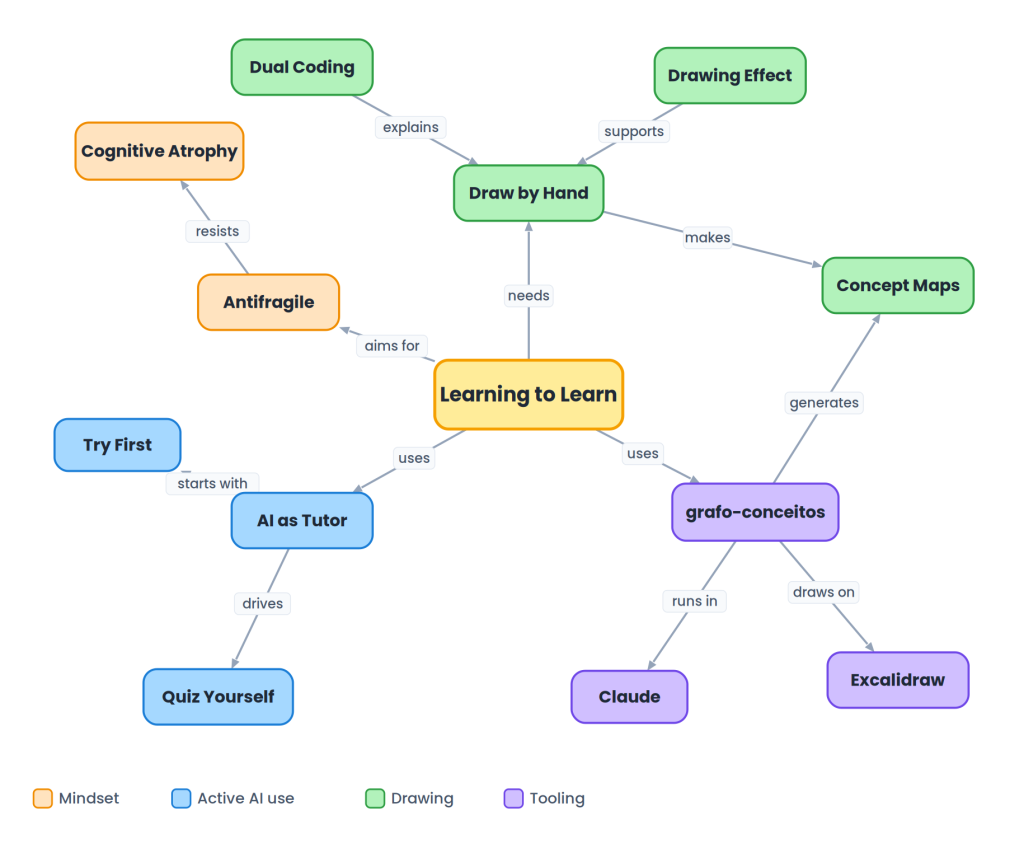
To get a running start, I built a small skill for Claude called grafo-conceitos, Portuguese for concept graph. I point it at whatever I am studying, a chapter, a meeting transcript, my own messy notes, and it pulls the structure out as a graph I can then redraw and argue with. Here is what it actually does:
- It pulls the core concepts out as nodes, somewhere between 6 and 20 of them, each labeled in one to three words, with synonyms collapsed into a single node so the picture stays clean.
- It turns the relationships into labeled edges, short verbs like “uses”, “depends on”, or “generates”, two words at most.
- It groups the nodes into two to four themed categories, one color each, so the clusters jump out at a glance.
- It lays everything out radially. It counts how many connections each concept has, drops the busiest one in the center as the hub, puts the well connected ideas in an inner ring and the rest on the outside, then arranges the angles so related nodes sit as neighbors and the arrows stay out of each other’s way.
- It draws the result on an Excalidraw canvas where every edge is truly bound to its two nodes, so when you grab a node and drag it, its arrows follow. That detail matters more than it sounds. A graph you can pull apart and rearrange is a graph you can think with.
Asking for it is one sentence:
Draw me a concept graph of this chapter on database indexing.
The map right under the title of this post was made the same way, from the post you are reading. One rule I keep: at most one or two graphs per topic. Past that it stops being a map and starts being noise.
Make the map yours
The skill hands you a first draft of the structure. The learning happens after that, when you redraw it by hand, move a node because you disagree with where it landed, add an edge it missed, tear one out that does not belong. The friction is the point, not a bug to optimize away. If it feels a little effortful, that is the muscle doing its job, which is the whole antifragile idea from the start: a bit of strain is what makes the thing grow.
What you have done
You saw why passive AI use quietly costs you, traded the oracle prompt for the tutor prompt, and turned a topic into a concept map, first with the grafo-conceitos skill and then with your own hand and your own disagreements. You are not memorizing the model’s answer anymore. You are building your own map and keeping it. Your brain stayed in the loop the entire time, which was always the point.
Next steps
- Quiz yourself with the same tool: Once the map exists, ask Claude to test you on the weakest cluster and explain only what you miss.
- Pair it with spaced repetition: Turn each node and edge into a flashcard so the map outlives this week.
- Teach it back: Explain your graph out loud to the model and let it poke holes. Teaching is the fastest way to find what you do not actually know.
- Expand a node: When one concept turns into a rabbit hole, ask for a subgraph of just that node and go a level deeper.
Questions, or a map you are proud of? Find me on LinkedIn or GitHub.